

From monitoring lowland tapir in Brazil, to lion and leopard conservation in Botswana, WildTrack's footprint identification work spans 5 continents — protecting biodiversity with local communities, without disturbing animals.
Our technology is used around the world.
Every project below started the same way — a species that is hard to find, a landscape that is hard to survey, and someone who looked down and saw footprints left behind. Working with local universities, community trackers and wildlife agencies, we turn those tracks into data points that field teams can act on.
Pick a project to open its dossier — who we work with, what we are measuring, and what the footprints are telling us. Use the arrows or your keyboard to move through them.
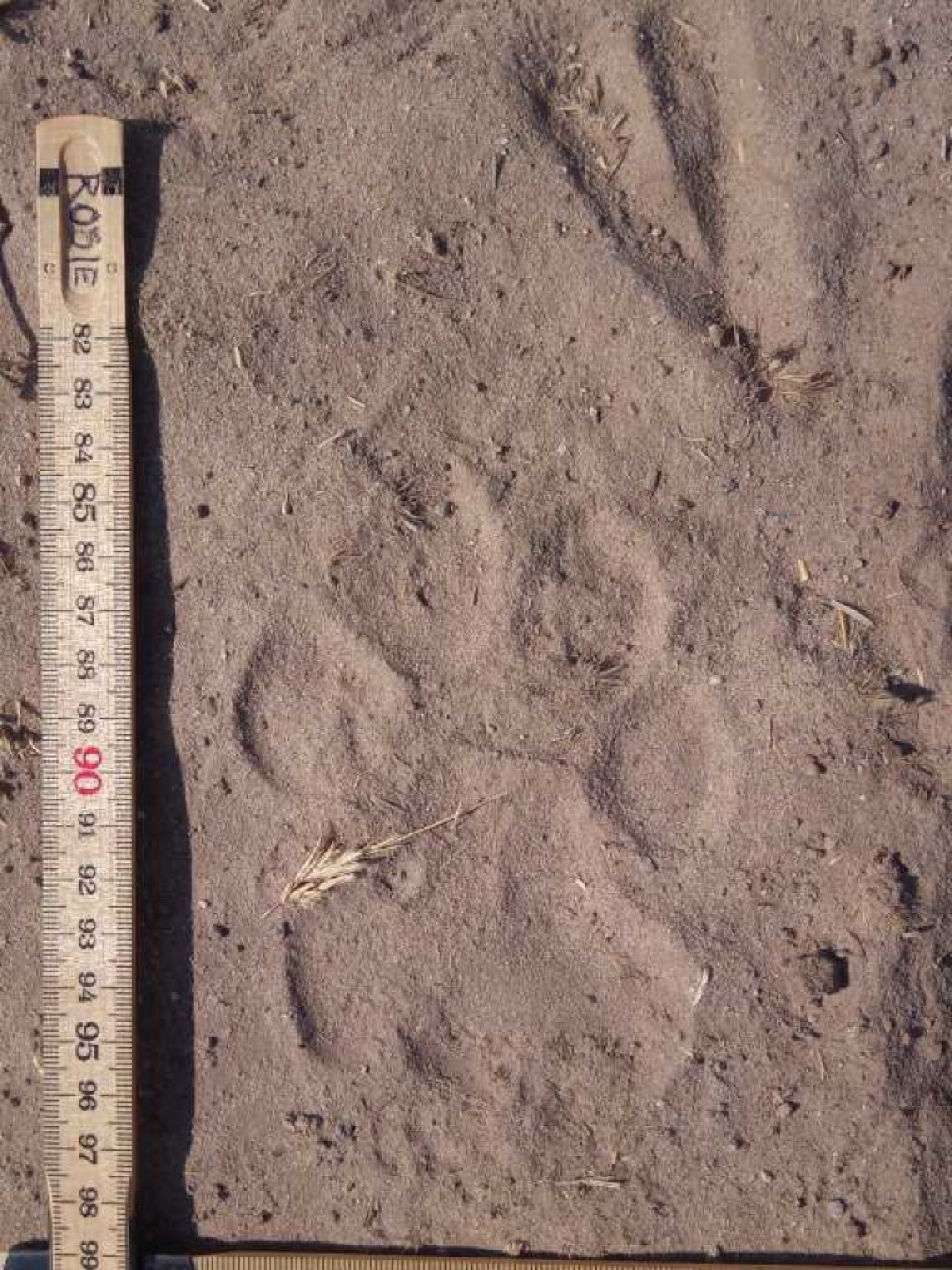
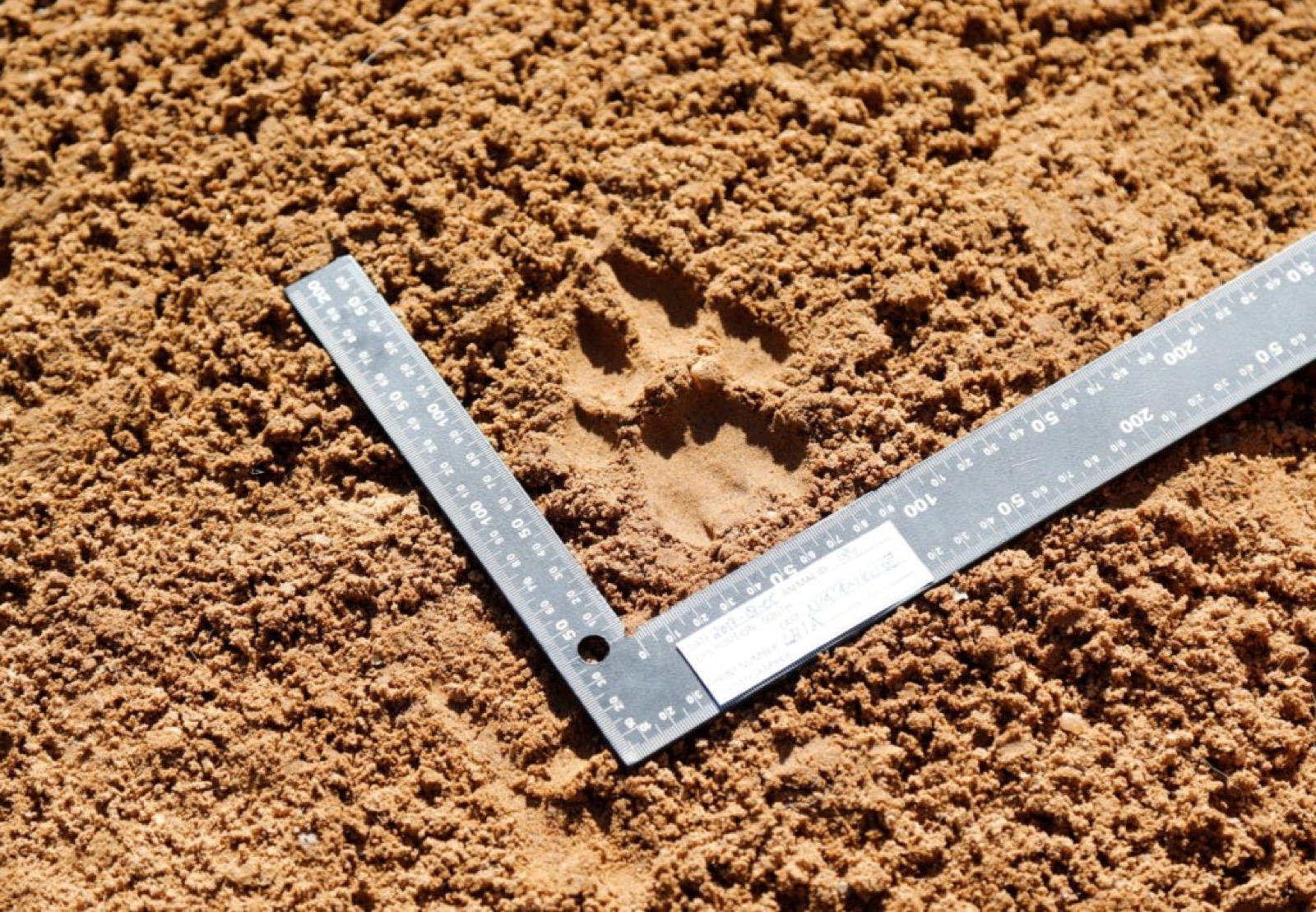
At Leopard Ecology & Conservation, researchers are working to promote the long-term survival of leopard and lion populations in Botswana by integrating conservation with community education. The low density of animals in the Central Kalahari makes many traditional scientific methodologies impractical — but the team includes local San Bushmen trackers whose knowledge of this environment is unrivalled. A significant proportion of the data collection relies on those trackers finding, following, and interpreting animal behaviour from the tracks of leopards and lions. Trackers are also involved in the reviewing of image data on our database, building skills in image processing. Early worries that the deep Kalahari sand would be too soft for usable tracks proved surmountable: around pans and along road edges, the sand is shallower and good-quality prints can be found. The team has already observed that these cats often register — the hind foot landing on top of the front — and that tracks are deeper at the rear than at the toes, the reverse of what is usually seen elsewhere.
Our projects are documented in the peer-reviewed literature. These papers show how footprint identification performs in the field — and what it changes for the species involved.
Moreira, D.O., Alibhai, S.K., Jewell, Z.C., da Cunha, C.J., Seibert, J.B. and Gatti, A., 2018. Determining the numbers of a landscape architect species (Tapirus terrestris), using footprints. PeerJ, 6, e4591.
Read the paperTucker, J.M., King, C., Lekivetz, R., Murdoch, R., Jewell, Z.C. and Alibhai, S.K., 2024. Development of a non-invasive method for species and sex identification of rare forest carnivores using footprint identification technology. Ecological Informatics, 79, 102431.
Read the paperPetso, T., Jamisola Jr, R. S., Alibhai, S., Lebopo, M., Peter, K., Namoshe, M. & Jewell, Z. (2026). Improving wildlife track classification through human-in-the-loop method and explainable AI. Sci Rep 16, 18395. https://doi.org/10.1038/s41598-026-48229-4 https://www.nature.com/articles/s41598-026-48229-4
Read the paperAlibhai, S., Avenant, N., Oosthuizen, M., Carlson, L., MacFadyen, D. and Jewell, Z., 2026. A non-invasive footprint technique for accurate identification of cryptic small mammal species: a sengi case study. Frontiers in Ecology and Evolution, 13, 1719684.
Read the paperOur projects sit alongside the research, the recognition, and the numbers behind WildTrack's global impact.
The full list of peer-reviewed papers, technical reports, and patents behind our methods.
Browse publications →The global numbers — countries, protected areas, species, and data points collected to date.
See our impact →The awards our non-invasive, community-led conservation model has earned along the way.
View awards →