
We’re excited to share some big news — WildTrack’s latest “Tracking Without a Trace” blog is now live on Faunalytics.
The article explores a simple but powerful idea: footprints could revolutionize wildlife monitoring.
For decades, researchers have relied on invasive techniques to understand wildlife populations — methods like trapping animals, handling them, or fitting them with transmitters and GPS collars. While these approaches can provide valuable information, they often come at a cost. They’re expensive, labor-intensive, and can cause stress that alters natural animal behavior. In some cases, the data collected may even be skewed by the very act of capturing or disturbing the animal.
What if there were a better way?
At WildTrack, we believe there is. Our work focuses on non-invasive monitoring — gathering critical scientific data without ever touching the animal.
Reading the ground, not the animal
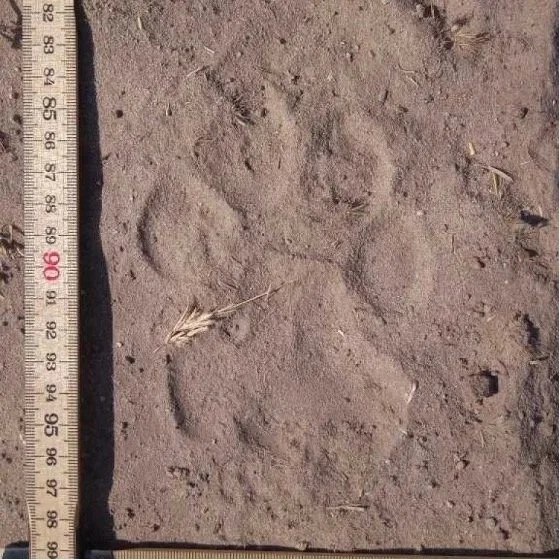
Using WildTrack’s Footprint Identification Technology (FIT), we can analyze a single footprint and extract extraordinary information. In some cases, the technology can even tell us that a track was made by a specific individual — for example, a male African lion named “Rocket.”
FIT combines centuries-old tracking knowledge with modern data science. Built on JMP statistical software, the system uses advanced algorithms and machine learning to identify individual animals from their footprints. The approach blends traditional tracking expertise, community science, and Indigenous knowledge with cutting-edge analytical tools.
The result is a clearer — and kinder — picture of wildlife populations.
We’re grateful to collaborate with organizations like Faunalytics that share our belief that animal welfare and rigorous science go hand in hand. Together, we’re encouraging the conservation community to rethink how wildlife monitoring is done.
Five principles for ethical monitoring
At the heart of this effort are five core ethical principles WildTrack believes should guide conservation monitoring:
- Use the gentlest method possible. Whenever feasible, choose non-invasive approaches that minimize stress and disruption to animals.
- Value individual animals. Every data point represents a living individual whose welfare matters just as much as population-level statistics.
- Follow up after the study ends. Researchers should check whether monitoring methods truly avoid harming animals or disturbing their social structures.
- Include local and Indigenous knowledge. Local communities and expert trackers possess invaluable insights that strengthen conservation efforts.
- Embrace interdisciplinary solutions. The most effective conservation strategies bring together biology, data science, AI, and traditional ecological knowledge.
Conservation, democratized
Imagine the possibilities if wildlife monitoring became something everyone could participate in. What if every visitor to a park simply stopped to photograph a footprint along the trail? With the right tools, those images could help build a global database of wildlife movement and population data.
In other words, conservation could become democratized — open to citizen scientists, trackers, researchers, and nature lovers alike.
We’re grateful to Faunalytics for helping us share this vision. Together, we can build a global movement for ethical wildlife monitoring — one footprint at a time.